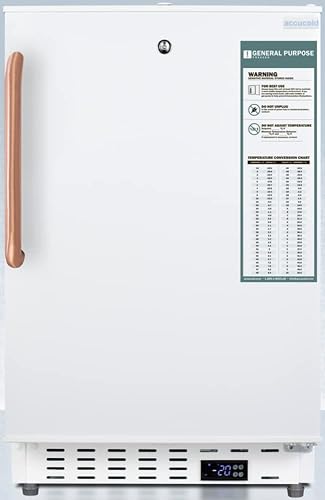
Energy reference
How many watts does a freezer use?
A chest freezer draws about 60–120 watts while its compressor is running — compact freezers less, large frost-free uprights up to roughly 300 watts. But a freezer compressor cycles on and off, so it only pulls that wattage part of the time — which is why a mid-size chest freezer actually uses roughly 200–300 kWh a year and a large frost-free upright 350–600 kWh. A freezer runs 24 hours a day, every day of the year, so annual kWh — not peak watts — is the number that compounds on your bill. The calculator below turns any wattage into a yearly running cost at your own electricity rate.
We may earn a commission when you buy through our links, at no extra cost to you. Learn more
Running-cost calculator
Typical category wattages, not a spec for any one model. Override below with your own.
On the nameplate or spec sheet (amps × 120 if only amps are listed).
From your electric bill. US average is about $0.17.
How much of the time it actually runs. ~33% is typical; warm rooms and frequent openings push it higher.
Estimate = watts × 8,760 hours × 33% duty cycle ÷ 1,000 × $0.17/kWh. If your fridge’s EnergyGuide label lists a kWh-per-year figure, that number × your rate is more accurate than any wattage estimate.
Typical wattage by type
These are typical published ranges for each category — a starting point, not a spec for any one model. Your freezer’s nameplate and EnergyGuide label have its real figures. Refrigerator rows are included for context: the physics is the same, a freezer just holds a colder setpoint.
| Type | Running watts | Energy / year |
|---|---|---|
| Compact freezer (1–3 cu ft) | 55–100 W | 150–250 kWh |
| Chest freezer (5–9 cu ft) | 60–120 W | 200–300 kWh |
| Chest freezer (10–20 cu ft) | 80–150 W | 250–400 kWh |
| Upright freezer, frost-free | 100–300 W | 350–600 kWh |
| Small mini fridge (for context) | 55–120 W | 200–400 kWh |
| Full-size refrigerator (for context) | 100–400 W | 400–800 kWh |
How to find your freezer’s real wattage
- Read the nameplate sticker (inside the lid or door, or on the back). If it lists watts, use that number.
- If it lists only amps, multiply amps × 120 volts. A 1.5-amp freezer is about 180 running watts.
- For the most accurate running cost, use the EnergyGuide label’s kWh-per-year figure and multiply by your electricity rate — it already accounts for cycling.
- A plug-in power meter measures actual draw over a day or week if you want to skip the estimating entirely.
Why rated watts overstate the real cost
A freezer does not run its compressor continuously — it kicks on to pull the temperature down, then coasts. Over a full day the compressor might run only a third of the time, so a freezer rated at 90 running watts averages closer to 30 watts. That is why the honest unit of comparison is kWh per year, and why the calculator above uses a duty-cycle input rather than assuming the compressor runs flat out. Warm rooms, poor ventilation, frequent lid openings, and heavy frost buildup all push the duty cycle — and the bill — up.
Chest freezers in particular are among the most efficient appliances in the house per cubic foot of storage, and the reasons are plain physics: cold air is denser than warm air, so when a top-opening lid lifts, the cold stays down in the well instead of spilling out the way it does from an upright’s door; most chest models are manual defrost, so they skip the periodic defrost-heater cycles a frost-free upright runs; and their walls carry thick insulation.
Planning to run a freezer in a garage or outbuilding? Ambient temperature changes the duty cycle in both directions — see Outside or in the garage. For the dollar breakdown of a freezer’s yearly bill, see What does a freezer cost to run?
Frequently asked questions
How many watts does a freezer use?
A chest freezer typically draws about 60–120 watts while its compressor is running; compact freezers sit lower, and large frost-free uprights can reach roughly 300 watts. The compressor only runs part of the time — commonly around a third — so a mid-size chest freezer uses roughly 200–300 kWh a year and a large frost-free upright roughly 350–600 kWh. For context, a small mini fridge draws about 55–120 watts and a full-size refrigerator about 100–400 watts while running.
How do I find my freezer’s wattage?
Look at the nameplate sticker inside the lid or door, or on the back. If it lists watts, use that. If it lists only amps, multiply amps × 120 volts to get watts (for example, 1.5 A × 120 V = 180 W). For running cost, the yellow EnergyGuide label’s kWh-per-year figure is the most accurate input of all.
Does a freezer use rated watts all the time?
No. A freezer compressor cycles on and off to hold temperature, so over a day it draws its rated wattage only a fraction of the time — commonly around a third, more in a warm garage or with frequent lid openings and heavy frost buildup. That duty cycle is why annual kWh, not peak watts, is what actually shows up on your bill. A full freezer coasts better between cycles, because frozen food holds cold.
How much does it cost to run a freezer per year?
At the US average of about $0.17 per kWh, a typical chest freezer at 200–300 kWh a year costs roughly $35–$50, and a large frost-free upright at 350–600 kWh roughly $60–$100. Use the calculator on this page with your own wattage and electricity rate for a personalized estimate.