Placement guide
Can You Put a Freezer in the Garage or Outside? Garage-Ready Ratings Explained
By MiniFreezer.com · Independently researched · Updated July 2026
You can put a freezer in the garage or outside only if the unit is rated for the temperatures it will face. A garage-ready freezer publishes a wide ambient operating range — Danby, for instance, rates one of its garage-ready upright freezers for 0°F to 110°F surroundings — while an outdoor-rated unit adds weatherized electricals and a rust-resistant cabinet for a covered patio. An indoor-only freezer is designed for room temperature: in a cold garage its thermostat can stop calling for the compressor — the classic garage failure — and outside, it is exposed to moisture its components were never sealed against.
We may earn a commission when you buy through our links, at no extra cost to you. Learn more
The short answer: it depends on the rating and the climate
“Can a freezer live in the garage?” is really two questions: what is the unit rated for, and what will the location actually throw at it? A covered patio in San Diego and an unheated Minnesota garage are different planets. The quick matrix:
The rest of this guide unpacks each cell — why cold confuses a compressor, what an outdoor rating physically changes, and how to power a freezer safely once it leaves the house. If you already know you need a rated unit, jump straight to our live roundups of garage-ready freezers and outdoor freezers.
Operating temperature ranges: why cold garages confuse a freezer
A freezer does not make cold; it moves heat from the inside of the box to the air around it, under the direction of a thermostat calibrated for room-temperature surroundings. Every part of that system assumes the ambient air sits in the band printed in the manual — and for an indoor-only freezer that band typically stops well above where an unheated garage lands in winter. Read the stated range before the freezer moves anywhere unconditioned.
Here is the classic failure, and it is counterintuitive: a cold garage does not help an indoor-only freezer — it can shut it off. As garage air falls toward freezing, the thermostat — which senses cold air, not the temperature of your food — reads the frigid room as “job done” and stops calling for the compressor. The cabinet then simply tracks the garage: fine during a deep freeze, but the moment a mild spell warms the garage into the 40s, the idle freezer drifts with it and the load can thaw and refreeze without you ever noticing. Cold ambients also drop refrigerant pressures and thicken compressor oil, working the machine outside its design envelope on the rare occasions it does start. Garage-ready models solve this with components and controls rated for the swings — some down to a stated 0°F floor.
Heat is the simpler enemy. In a 100°F+ garage in summer, the compressor runs nearly continuously to fight the gradient, energy use climbs, and component life shortens. That is why garage-ready models are rated at both ends of the scale. A conditioned basement, by contrast, usually stays inside the normal indoor band all year — which is why an ordinary unit from our basement freezer roundup rarely needs any special rating.
Outdoor-rated vs indoor freezers: what makes a unit outdoor-safe
An outdoor rating is not a sticker — it changes the hardware. Compared with an indoor unit, an outdoor-rated freezer typically has:
- Weatherized electrical components, tested and certified (commonly by UL) for damp outdoor locations, so humidity and splashes do not reach live parts.
- A corrosion-resistant cabinet — usually stainless steel — that shrugs off humidity, salt air, and cleaning spray instead of rusting through.
- More aggressive insulation and cooling capacity, sized to hold set temperature on a hot patio rather than in a climate-controlled kitchen.
- Front ventilation on built-in models, so the unit can be enclosed in an outdoor kitchen island without cooking its own compressor.
One important caveat: outdoor-rated does not mean waterproof. Even rated units are meant for covered locations — under a roof, bar top, or pergola — not standing in open rain and direct sun. And the distinction cuts the other way too: a garage-ready freezer is rated for temperature swings, not weather, so it still belongs under a real roof with dry power. Browse the full field of outdoor and patio freezers to compare builds.
Running a freezer in the garage through winter and summer
The garage is the most popular spot in the house for a chest or upright freezer, and it works year-round if you pick and place the unit deliberately:
- Buy the rating, not the hope. A garage-ready unit states its ambient range in the spec sheet — Danby’s garage-ready 8.5 cu ft upright freezer, for example, is rated by the manufacturer to perform from 0°F to 110°F. If your winters dip below the stated floor, the rating does not apply to you.
- Give the freezer its own thermostat. A dedicated chest freezer or upright freezer holds frozen food far more reliably in a cold garage than the freezer shelf of a combo mini fridge, whose single fresh-food thermostat idles the whole machine when the room is cold.
- Place it out of the sun. Keep the unit off the sun-facing wall and away from the garage door, leave the manufacturer’s clearance around the sides and back, and set it on a level, dry slab — not against a wall that bakes all afternoon.
- Watch the first cold snap. Put a cheap freezer thermometer inside the cabinet during the first week of real winter. If the reading drifts warm while the garage is cold — or after the first mild spell that follows — you have found the idle-thermostat problem in action, and the unit is not garage-ready in practice.
Our garage-ready freezer roundup filters the catalog to models rated for exactly this duty — 183 live models as of this update, and the garage freezers page covers the wider field of units people actually run in garages.
Outdoor cabinets and covers: protecting a freezer on a patio or deck
Even an outdoor-rated freezer lasts dramatically longer with shelter. The goal of any enclosure is simple: block rain and direct sun without blocking airflow. A compressor freezer rejects heat continuously, and a sealed cabinet turns into an oven that forces the unit to fight its own exhaust.
- Building it in? Use a front-venting, built-in-rated model and follow the manufacturer’s cutout dimensions exactly — they already include the minimum clearances. For rear-venting freestanding units, leave a few inches on the sides and back and never box in the top.
- DIY cabinet on a deck: a simple three-sided surround with a roof overhang and louvered or slatted panels gives rain and UV protection while letting the condenser breathe. Cement board or exterior-grade plywood with a vented back panel is a common weekend build.
- Get it off the ground. Set the freezer on pavers or a raised platform so pooling rainwater and splash-back never reach the base, and keep it level so the door seals and the compressor oil sits correctly.
- Off-season storage: if the freezer will sit unused through winter, unplug it, empty and dry the interior, prop the lid or door open an inch to prevent mildew, and use a breathable cover — a tarp wrapped tight traps condensation against the cabinet and does more harm than good.
Power and safety outside: GFCI outlets, cords, and moisture
Electricity and weather need refereeing. Three rules cover almost everything:
- Use a GFCI-protected outlet. The US National Electrical Code requires GFCI protection on outdoor receptacles, and for good reason: if moisture ever creates a fault path, the GFCI cuts power in milliseconds. Pair it with a weather-resistant receptacle and an in-use “bubble” cover so the plug stays protected while connected.
- Skip the extension cord if you possibly can. Manufacturers almost universally advise plugging a freezer directly into a wall receptacle. If a cord is truly unavoidable for a short-term setup, it must be an outdoor-rated, grounded, heavy-gauge cord kept as short as possible — and never run through a pinched door or window gap.
- Keep connections up and dry. Route the plug so the connection point sits above grade, never in a spot where water pools or sprinklers hit. If a GFCI trips repeatedly with the freezer on the circuit, treat it as a warning about moisture in the works, not an inconvenience to bypass.
For a sense of the electrical load itself — startup surge versus running draw — see our wattage and amps guide.
Why the outside of a freezer gets hot — normal vs a problem
People moving a freezer to a garage often touch its flanks for the first time and worry. Here is what is happening: many chest and compact freezers have a skin condenser — the heat-rejection tubing is bonded to the inside of the outer cabinet walls, so the side panels literally are the radiator. Warm-to-hot sides during a first cool-down, after loading a bulk grocery haul, or on a hot day are the design working as intended.
It crosses into problem territory when three things happen together: the sides stay uncomfortably hot for hours, the compressor never cycles off, and the inside is not reaching temperature. That combination usually means the unit cannot shed heat — clearance blocked by a wall or clutter, dust-matted coils, an enclosure with no airflow, or ambient heat beyond the unit’s rating. Give it breathing room and clean the coil area first, and if heavy frost is choking the interior, our defrosting guide walks through the fix. And remember the placement corollary: the hotter the space, the more heat the freezer must dump into it — a packed, sun-baked garage makes every problem above more likely.
Garage-ready and outdoor-rated freezers we track
Real models from our live catalog — we currently track 183 freezers that match our garage-ready filter. No ratings or urgency here; tap through for full specs and the current price.
Thor Kitchen
24 Inch Undercounter Built-In/Freestanding Drawer Freezer – Stainless Steel | Gordon Ramsay Series
Compact Freezers · 5.4 cu ft
- Easy Installation: Unit available as built-in or freestanding for easy installation in any space.
- Convection Cooling System: Convection cooling system provides a quick cool down and consistent temperature.
Danby
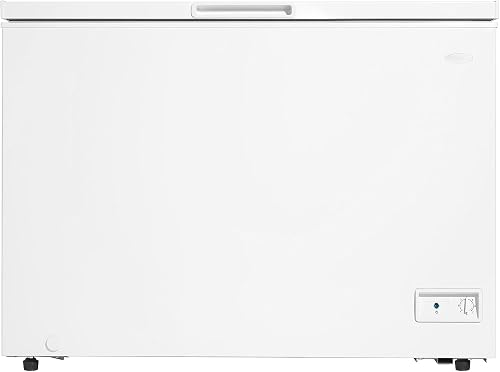
Danby DCF035A6WM 3.5 cu. ft. Square Model Chest Freezer DOE Front mounted mechanical thermostat: Easy to use, adjustable variable temperature range
Chest Freezers · 3.5 cu ft
- 3.5 cu. ft. capacity (99.11 Litres): Store more of your favorite frozen foods and optimize bulk food storage.
- Front mounted mechanical thermostat: Easy to use, adjustable variable temperature range
Danby
Danby 5.0 cu. ft. Square Model Chest Freezer DOE in White DCF050A6WM
Chest Freezers · 5 cu ft
- 5.0 cu. ft. capacity (141.58 Litres): Store more of your favorite frozen foods and optimize bulk food storage.
- Front mounted mechanical thermostat: Easy to use, adjustable variable temperature range.
Danby
Danby DCF100A6WM 10.0 cu. ft. Square Model Chest Freezer DOE Front mounted mechanical thermostat: Easy to use, adjustable variable temperature range
Chest Freezers · 10 cu ft
- 10 cu. ft. capacity (283.17 Litres): Store more of your favorite frozen foods and optimize bulk food storage
- Front mounted mechanical thermostat: Easy to use, adjustable variable temperature range
Frequently asked questions
Can a freezer stay in an unheated garage through winter?
Only if it is rated for it. An indoor-only freezer is designed around room-temperature surroundings; in a garage that drops toward freezing, its thermostat can stop calling for the compressor, refrigerant pressures fall outside the design range, and during warm swings the load can thaw. Garage-ready models publish a wider ambient operating range — Danby, for example, states its garage-ready upright freezer performs in ambient temperatures from 0°F to 110°F. Check the manual for the stated range before wintering any freezer in the garage.
What temperature is too cold for a freezer in a garage?
For an indoor-only freezer, trouble typically starts once the garage falls below the low end of its stated ambient band — often somewhere in the 50s°F, and the manual is the only reliable source for the exact floor. In very cold air the thermostat sees little difference between the room and the cabinet, so the compressor runs rarely; then a mild spell warms the garage faster than the idle freezer responds. Garage-ready models are the exception — they state a low-ambient limit (some down to 0°F) right in the spec sheet, so match the rating to your winters.
What does "garage ready" actually mean?
It means the manufacturer has tested and rated the freezer to keep holding temperature across the wide ambient swings of an unheated garage — typically a stated range printed in the specifications rather than a vague marketing claim. It is a rating for temperature extremes, not for rain: garage-ready is not the same as outdoor-rated, and a garage-ready freezer still needs a dry, covered location.
Does an outdoor freezer need a GFCI outlet?
Yes. In the US, the National Electrical Code requires GFCI protection for outdoor receptacles, and it is the right call regardless of code: a ground-fault interrupter cuts power in milliseconds if moisture creates a leakage path. Plug the freezer directly into a weather-resistant GFCI receptacle with an in-use (bubble) cover rather than running an extension cord out a door or window.
Can I keep a regular indoor freezer on a covered patio?
It is a gamble the manufacturer has usually already declined for you — most indoor-only manuals state the unit is not for outdoor use, and doing so can void the warranty. A roof solves rain but not humidity, condensation, temperature swings, or insects reaching non-weatherized electricals. In a mild, dry climate an indoor unit may survive on a well-protected patio for a while, but if the freezer will live outside, an outdoor-rated model is the honest answer.
Why is the outside of my freezer hot to the touch?
Warm side walls are normal. Many chest and compact freezers route the condenser under the outer skin, so the cabinet itself is the radiator that dumps the heat pulled from inside — especially noticeable during a first cool-down or in a hot garage. It becomes a problem when the sides stay uncomfortably hot for hours while the compressor never shuts off and the inside is not holding temperature; that points to blocked ventilation clearance, dust-caked coils, or ambient heat beyond the unit’s rating.
We may earn a commission when you buy through our links, at no extra cost to you. Specifications and operating ranges cited above come from manufacturer and retailer listings for the exact models named; always confirm the ambient rating in the manual for your unit before installing it outdoors or in a garage.