Operation
What Temperature Should a Freezer Be? 0°F, Deep-Freeze, and the Settings Explained
By MiniFreezer.com · Independently researched · Updated July 2026
A freezer should be at 0°F (-18°C) — the USDA standard for frozen storage, cold enough to stop bacterial growth entirely and hold food quality. Deep freezing around -10°F is worth using when bulk-loading fresh food or storing for many months. Anything above 32°F means the cabinet is no longer freezing at all — and once perishable food spends 2 or more hours above 40°F, USDA guidance says to discard it. Verify with a freezer thermometer placed between packages, not the dial.
We may earn a commission when you buy through our links, at no extra cost to you. Learn more
The settings, decoded
Freezer controls express the same physics three ways — a digital readout in degrees, a numbered dial, or a bare min–max slider. Whatever the interface, these are the temperatures that matter:
| Setting | What it means | When to use it |
|---|---|---|
| -10°F (-23°C) | Deep-freeze territory. Well below the standard; freezes fresh food faster and slows quality loss further, at a higher energy cost. | Bulk-loading a harvest or a meat order, flash-freezing fresh food, or long-term storage where quality over many months matters most. |
| 0°F (-18°C) | The USDA standard for frozen storage. Bacterial growth is fully stopped; the storage-chart quality windows assume this temperature. | The everyday setting for every home freezer. If in doubt, set 0°F. |
| 10°F (-12°C) | Food stays frozen solid and safe, but enzyme activity and moisture migration run faster — quality windows shrink and freezer burn accelerates. | Not a setting to choose. If a thermometer reads here at the correct dial position, the freezer is struggling: check the gasket, frost, and ambient temperature. |
| Above 32°F (0°C) | The cabinet is no longer freezing — food is thawing. Once perishables spend 2 or more hours above 40°F, USDA guidance says discard them. | Never. A freezer reading above 32°F is failing, mis-set, or in an environment it cannot handle — treat it as an emergency for the food inside. |
Why 0°F, specifically
0°F is where the two clocks inside a freezer diverge for good. The safety clock — bacterial growth — stops completely once food is solidly frozen, and 0°F holds it stopped with margin to spare. The quality clock keeps ticking at any temperature: enzymes dull flavor, and moisture migrates out of food and into frost. 0°F slows that quality clock enough that the USDA storage windows — 12 months on a whole chicken, 8–12 on frozen vegetables — actually hold. Warmer cabinets keep food safe but burn through those windows faster.
Colder than 0°F buys slower quality loss and faster freezing of fresh food, paid for in compressor run-time. Many chest freezers will pull -10°F or lower — that is the “deep freeze” — and the sensible pattern is to use it when loading a lot of unfrozen food, then return to 0°F for storage.
What the controls look like across real freezers
Across the 2391 freezers we track, 1830 describe an adjustable thermostat or temperature control in their manufacturer listings, and 241 of them advertise digital or electronic controls — the kind where you set 0°F on a display instead of guessing at a dial. If precise temperature matters to you — medicine, expensive meat, long-term storage — the digital-control models remove the guesswork entirely.
compact-freezer · 5.4 cu ft
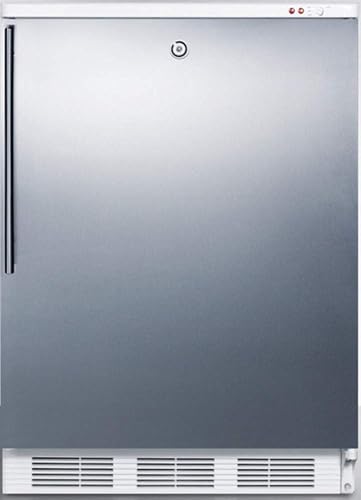
Easy Installation: Unit available as built-in or freestanding for easy installation in any space.
upright-freezer · 19 cu ft
✅ Advanced Cooling Technology: Engineered with a high-performance Cubigel compressor and environmentally-friendly R290 refrigerant, this stainless steel commercial freezer delivers superior cooling efficiency while reducing energy consumption by 40%. Its optimized airflow system maintains perfectly even temperatures throughout the unit - ideal for busy restaurants and supermarkets that demand reliable refrigeration.
How to verify the real temperature
- Get a freezer thermometer. An inexpensive appliance thermometer rated for below-zero readings — analog or digital both work.
- Put it where the food lives. Between packages in the middle of the load, not clipped to a wall or floating in the air path — walls and vents read colder than the food does.
- Read it after it has fully settled. A thermometer needs hours to reach the load temperature, and a reading taken right after loading groceries reflects the groceries, not the freezer. A first-thing-in-the-morning reading, before the door has been opened, is the gold standard.
- Adjust one step at a time. Move the dial one position, give the cabinet a full cycle to stabilize, and re-read. Chasing the number with big dial swings overshoots in both directions.
- Leave the thermometer in. A permanent thermometer is also your early-warning system: a slow drift upward at the same dial setting is how a dying gasket or thermostat announces itself, and it is the first thing to check after a power outage.
The garage caveat
Every temperature in this guide assumes the freezer is standing in a normal room. Garages, sheds, and porches break that assumption in both directions: summer heat forces the compressor to work far harder to hold 0°F, and — counterintuitively — a cold winter garage can fool a freezer’s thermostat into not running at all, letting the cabinet drift up toward the ambient temperature while looking perfectly idle. Manufacturers publish rated ambient operating ranges for exactly this reason, and “garage-ready” models are rated for wider ranges. The full picture — ratings, covers, GFCI power, and what actually survives an unheated garage — is in our garage and outdoor placement guide, with real models in the garage-ready shortlist.
Frequently asked questions
Is 0°F really necessary, or is "pretty cold" good enough?
Food stays technically safe at any temperature that keeps it solidly frozen, but 0°F is the standard for a reason: it is cold enough to stop bacterial growth entirely and slow the enzyme and moisture activity that degrades quality. A freezer sitting at 10°F keeps food frozen yet burns through the quality windows in the storage chart noticeably faster. Since a home freezer at 0°F versus 10°F costs little difference to run, there is no good reason to settle warmer.
What number should the dial be set to?
The 1–7 dial on many freezers is not a temperature — it is a duty-cycle knob, and the mapping varies by model. Higher numbers mean colder on nearly all of them. Start at the middle position, put a freezer thermometer between food packages, check after a full day, and adjust one step at a time until it holds 0°F. A freezer with digital controls skips the guesswork: you set 0°F directly and the display confirms it.
Why is my freezer freezing but the food is still getting freezer burn?
Freezer burn is about moisture loss, not just average temperature. Loose packaging with trapped air is the usual cause, but temperature swings matter too: frequent door openings, a leaking gasket, or the defrost cycles of a frost-free model each nudge the cabinet warmer and back, and every swing moves moisture out of the food. A steady 0°F with tight, air-free packaging is the fix on both fronts.
Can I trust the built-in temperature display?
Treat it as a helpful estimate, not a verification. Built-in sensors typically sit near the cabinet wall or in the airflow path, which can read colder or warmer than where the food actually sits. An inexpensive freezer thermometer placed between packages in the middle of the load is the honest reading. If the built-in display and the package-level thermometer disagree, believe the thermometer and offset the setting accordingly.
We may earn a commission when you buy through our links, at no extra cost to you. Temperature figures are USDA guidance; specifications are drawn from manufacturer and retailer listings and cited as such.